


Technical annex Download
5 Data collection
The GP Patient Survey (GPPS) has historically used a simultaneous push-to-web approach, offering the option to take part online or via a paper questionnaire in every mailing. From 2024 onwards, the contact strategy for GPPS has changed to a sequential push-to-web methodology, meaning that a paper questionnaire is only enclosed in the last reminder mailing. This was a result of a series of experiments conducted in 2022 and 2023 which demonstrated that it was possible to save a significant amount of money by removing a paper questionnaire from the first two mailings and, where a mobile phone number was available, to replace the second physical mailing with an e-letter.
Building on this approach and following further testing in 2025, in 2026 there were some changes to the mailing strategy designed to produce significant cost savings while maintaining data quality:
-
the final paper mailing was replaced with an SMS linked to an e-letter or an RCS (branded text message with more interactive features) for 50% of those under 70. The remaining 50% of 16-69 year olds and everyone aged 70 and over received a letter with a paper questionnaire.
-
an email was added to the mailing strategy for anyone with a valid email address in the sample (around 70%).
To maximise participation, patients can also take part by telephone, and the survey is offered in a variety of accessible formats. The overall contact strategy and processes are described in greater detail below.
Note that although patients are offered several methods of completion, only one completed survey per patient is included in the final data.
5.1 Contact strategy
The contact strategy and dates are shown in Table 5.1. The initial mailing is a letter, which includes a link to the online survey inviting people to take part. Subsequent contact varies, depending on the contact details available for each individual, but is likely to involve a series of reminder text messages supplemented with email. Towards the end of fieldwork, an additional email was added to the contact strategy to help improve response rates.
Table 5.1: Contact strategy and dates
| Dates | Contact |
|---|---|
| 2 January – 6 January 2026 | Initial invitation letter |
| 13 January – 15 January | Text message reminder |
| 16 January – 24 January | Email reminder |
| 26 January – 29 January | Text message or e-letter via SMS (or paper letter if no mobile number) |
| 3 February – 5 February | Text message reminder |
| 23 February – 25 February | Group 1: Letter with paper questionnaire (all aged 70+ and 50% aged 16-69) |
| 24 February – 26 February | Group 2: Text message or e-letter via SMS (50% aged 16-69) or letter if no mobile number |
| 3 March – 5 March | Text message reminder |
| 17 March – 19 March | Text message reminder |
| 23 March - 2 April | |
| 13 April | Fieldwork Close |
Some of the experiment groups followed slightly different mailing timings. More detail on the experiment design can be found in the appendices.
5.2 Mailing process
The final survey sample is delivered to the printing house via secure file transfer protocol (SFTP), using high level encryption. Upon receipt it is cleaned using the Postcode Address File (PAF), a process which ensures that the letters are sent to the correct postal address and that the mailing is eligible for postage discounts. A downstream access provider is used for processing the mailing packs, with items then handed over to Royal Mail for ‘final mile’ delivery.
All letters and questionnaires are digitally printed as required, ahead of each postal mailing. C5 Business Return envelopes, and C5 outer envelopes are also printed in advance. The letters are personalised with name, address, and the individual’s unique access code, which also appears on the questionnaire. The relevant materials are packed into an outer envelope by machine, and sorted into national or zonal batches, ready for collection by the downstream access provider.
5.3 Text messages
The final mobile number sample is delivered to the text message provider via secure file transfer protocol (SFTP), using high level encryption. All text messages are personalised with a short URL that is unique to each patient, allowing them direct access to the online survey.
Where handsets were enabled, texts were sent using Rich Communication Services (RCS), which enables users to send branded text messages (including the NHS logo) and information that shows the sender has been verified by the mobile network. A capability check, conducted in December 2025, identified whether the mobile numbers in the selected sample could receive RCS messages. This found 61% of devices were RCS-enabled. Consequently, RCS-capable device owners received RCS reminders, while others received SMS reminders and SMS with a link to an e-letter.
To manage the volume of text messages being issued into the mobile network at any time, an automated system schedules a set number of messages per second (TPS). Text messages were sent over three days (Tuesday to Thursday), from 9am – 9pm.
5.4 Emails
The email reminder was sent during the third week of fieldwork, to everyone with a valid email address who had not yet completed the survey or asked to opt-out of taking part. To avoid the emails being blocked by the main internet service providers or being diverted by spam filters, they were scheduled over a nine-day period.
Towards the end of fieldwork, an additional email reminder was sent as a further prompt to non-responders and to improve overall response rates. Based on evidence from the initial email, these were scheduled across a ten-day period to help improve delivery rates.
5.5 Handling reminders
Patients who were not sent a reminder, included those who met the following criteria at the point of the relevant deadline:
-
had taken part in the survey online.
-
had taken part in the survey via the helpline.
-
had telephoned or emailed the helpline and opted out of the survey.
-
had opted out via NHS England.
-
any letters returned as undeliverable(opted out of paper mailings only).
-
any undeliverable text messages (opted out of text message reminders only).
-
individuals recorded as deceased or no longer eligible on the NHS England database.
As outlined in Chapter 3: Sampling, this year, ahead of delivery of the final mailing packs eligible addresses were reviewed against a database of movers. In order to save on printing and postage costs these people were not sent the final mailing.
5.6 Online completion
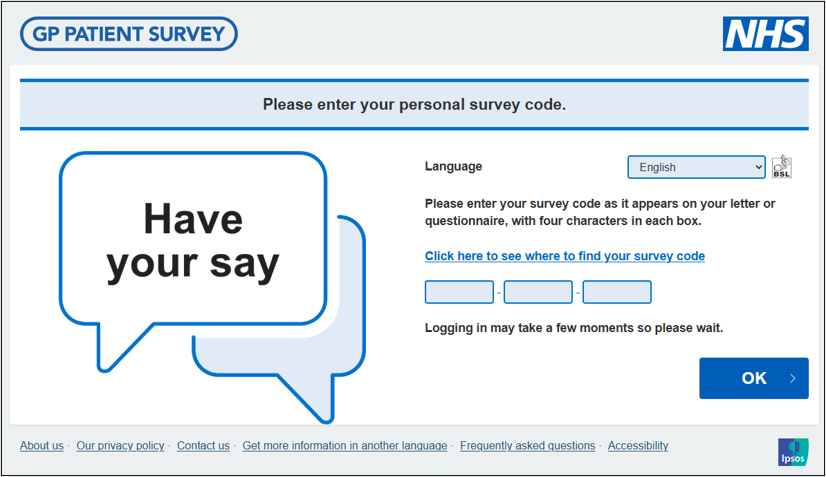
Each patient in the sample is assigned a unique access code (printed on the letter and on the front page of the paper questionnaire) that allows them to access the online survey via the survey website (www.gp-patient.co.uk/survey) or by using a shortened URL available in the letter (www.gpsurvey.net/login).
To complete the survey online, patients are required either to enter their unique survey code on a login screen (see Figure 5.1). They can also click on the unique URL in the digital contacts, or scan a QR code on their letter.
Figure 5.1: Login screen for online survey
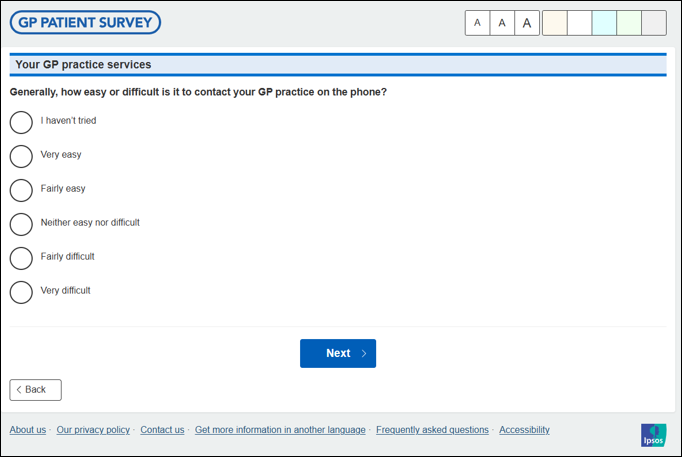
The questions in the online survey are identical to those on the paper questionnaire in terms of wording and design. To ensure comparability between the online survey and paper questionnaire, participants are able to skip questions in the online survey. However, a soft prompt asks them if they are sure they want to skip each question, to encourage completion. The online survey includes large answer option buttons, keyboard navigation, and labelled ‘Next’ and ‘Back’ buttons to improve accessibility. The online survey is also compatible with screen reader software on both desktop and mobile devices.
Figure 5.2: Question from the online survey
Only one online response per patient is accepted. If patients try to complete the survey more than once online, a message appears letting them know they have already completed it. If they do not complete the survey in one sitting, their unique access code will return them to their previous location.
In 2026, the progress bar at the top of the web page for the online script was removed to help to encourage people to continue completing the survey once they have started.
5.6.1 Total number of online returns
Overall, 566,443 patients completed the survey online during fieldwork in 2026 (compared with 585,338 in 2025). The proportion of patients completing the survey online has increased over time as shown in Table 5.2. The larger increases since 2019 were driven by changes in how participants are approached (e.g. via text message and removing paper questionnaires from each mailing), designed to drive more people to take part online.
Table 5.2: Number and proportion of online returns
| Number of online completes | Online completes as a percentage of all completes | |
|---|---|---|
| 2026 | 566,443 | 86.5% |
| 2025 | 585,338 | 83.3% |
| 2024 | 563,585 | 80.5% |
| 2023 | 344,936 | 45.4% |
| 2022 | 292,929 | 40.7% |
| 2021 | 314,508 | 37.0% |
| 2020 | 150,274 | 20.3% |
| 2019 | 78,657 | 10.2% |
| 2018 | 69,512 | 9.2% |
| 2017 | 47,440 | 6.0% |
5.6.2 Alternative online formats
Patients are offered several alternative methods of completion to ensure the survey is as accessible as possible. This includes the option to complete the online survey in one of 14 languages offered (in addition to English), or in British Sign Language (BSL). These versions of the survey are accessible from the specific language pages on the website or via a language drop down on the online survey login page (see Figure 5.1). Using one of these routes, patients may choose the language in which they wish to complete the survey (English, Arabic, Bengali, Chinese (Simplified), French, Gujarati, Italian, Polish, Portuguese, Punjabi, Romanian, Somali, Spanish, Turkish or Urdu).
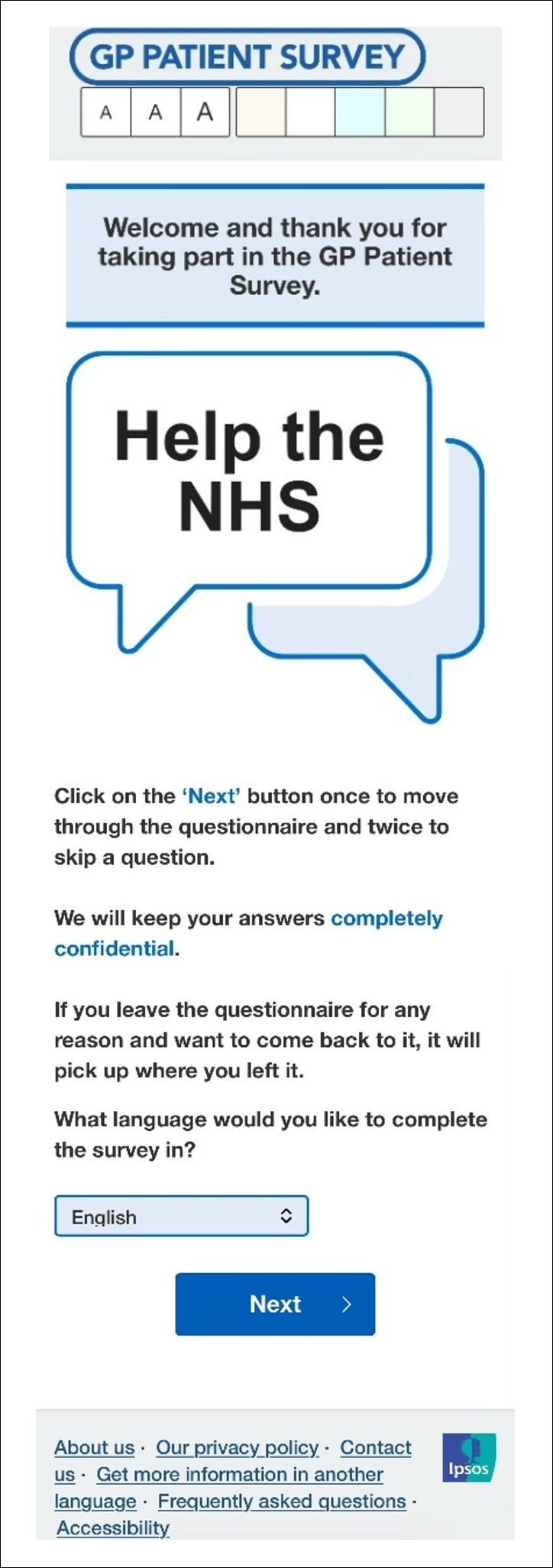
For those entering the online survey via the shortened URL in the letter (www.gpsurvey.net/login (only active while survey is live)) or the short link in the SMS or e-letter, there is a language selection option on the login page (see Figure 5.3).
Figure 5.3: Introduction page for SMS route to online survey with language selection option
Likewise, the option for patients to access the BSL version is via the page dedicated to supporting BSL users. This involves showing video clips of a BSL user signing the instructions, questions, and options available (see Figure 5.4). There is a BSL logo on the survey log-in page to help promote this option (see Figure 5.1).
Figure 5.4: Viewing the questionnaire in BSL
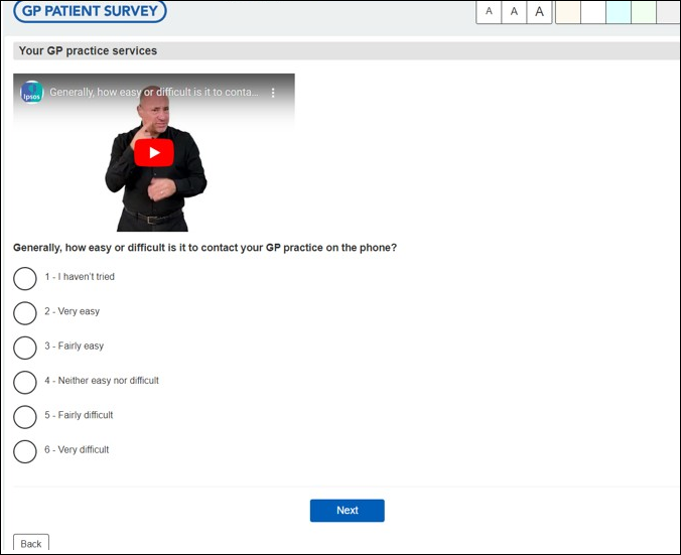
Table 5.3 details how many patients completed the 2026 survey in each available additional language and BSL. Overall fewer took part online in another language (7,641 in 2026 compared with 9,899 in 2025) or using BSL (275 in 2026 compared with 378 in 2025) .
Table 5.3: Completes per language and BSL
| Completes | |
|---|---|
| Arabic | 916 |
| Bengali | 216 |
| Chinese | 1,155 |
| French | 170 |
| Gujarati | 162 |
| Italian | 204 |
| Polish | 1,790 |
| Portuguese | 561 |
| Punjabi | 124 |
| Romanian | 1,051 |
| Slovak | 128 |
| Spanish | 607 |
| Turkish | 451 |
| Urdu | 106 |
| Total | 7,641 |
| BSL | 275 |
5.7 Telephone completion
Patients are also able to take part in the survey on the telephone (including in the 14 additional languages) by calling the Freephone helplines. Patients are asked for their unique access code before they can complete the survey and there is an automatic check on the access code to ensure that it is valid for the live survey. Helpline staff enter callers’ answers directly into the online version of the survey. In total, the helpline team assisted 503 patients in completing the survey during 2026 fieldwork, mostly because they did not have the digital skills or lacked internet access to complete the survey online, but some also had a visual impairment.
In 2022, a Text Relay service was also added to the helpline. However, no participants completed the survey using this service in the 2026 survey.
5.8 Braille and large print versions
Braille users are offered the opportunity to receive the questionnaire and letter in Braille and can then take part in the survey online. Large print is also made available for those who request a copy of the letter and questionnaire in this format. Returned large print questionnaires are entered manually into the online survey by the helpline team, using the patient’s unique access code. This year there were 131 requests for a large print survey, of which 46 were returned. There were no requests for a Braille version this year.
5.9 Respondent burden
Respondent burden provides information on the burden of those taking part in the survey. It is calculated using the Compliance Cost Model1 formula shown below:


For the 2026 GP Patient Survey the total compliance cost was 9,800,844 minutes. This is based on 654,714 full completes (online and paper) and 162,023 partial completes (to the online survey), with a median online completion time of 12 minutes.